A recent breakthrough in chemical protein synthesis, led by researchers Zhenquan Sun, Yaoyue Zhang, and their team, highlights the critical role of pyridium-π interaction in preserving N,S-benzylidene thioacetals during acidolysis. This advancement, published in Nature Communications, promises to overcome significant challenges in the synthesis of difficult peptides and proteins.
Revolutionizing Chemical Protein Synthesis
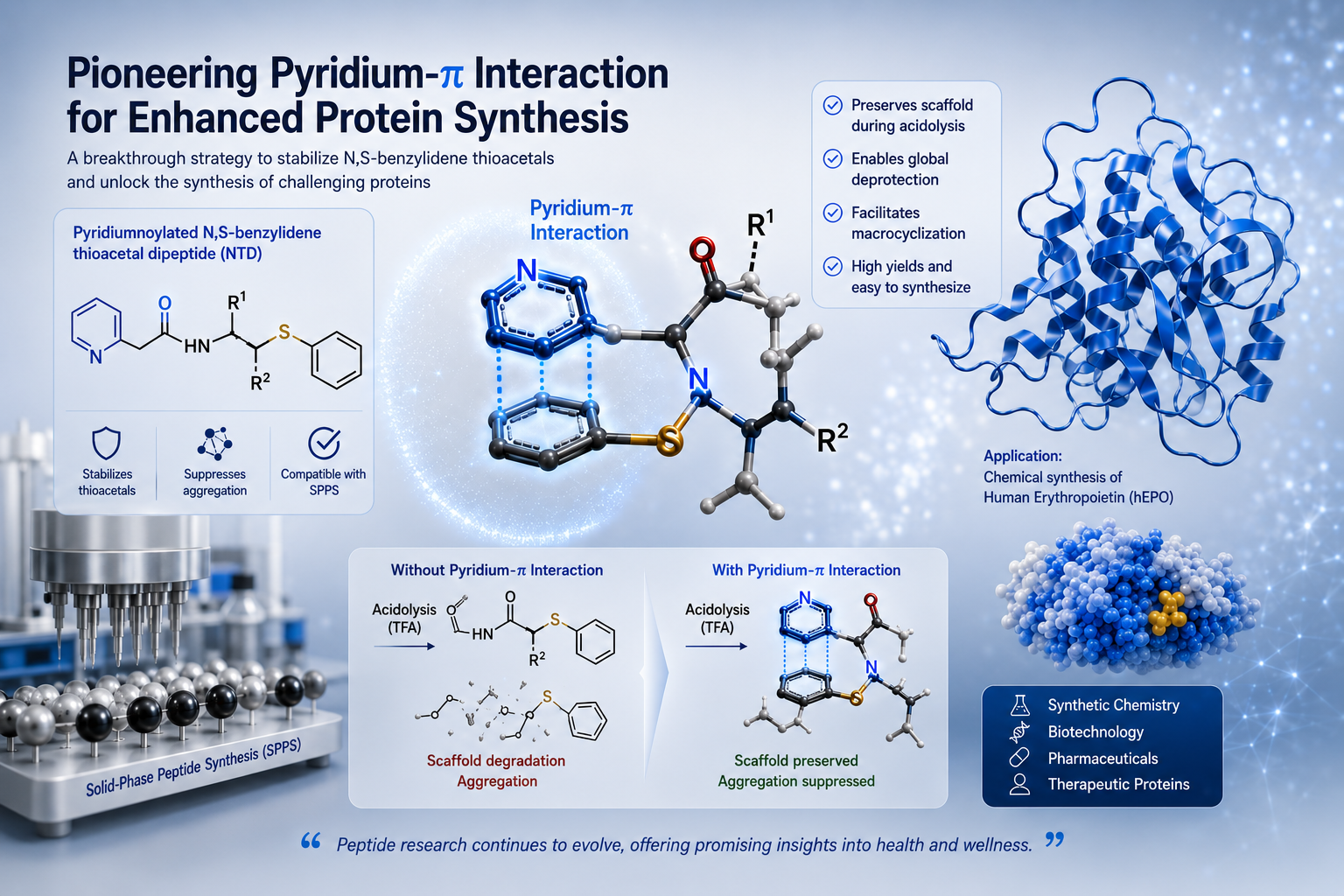
The study introduces a novel strategy using picolinoylated N,S-benzylidene thioacetal dipeptides (NTDs) to stabilize peptide structures during synthesis. These NTDs act as effective aggregation disruptors, which are crucial for producing peptides that are prone to aggregation. Notably, they can be synthesized in high yields and easily integrated through standard solid-phase peptide synthesis (SPPS).
Pyridium-π Interaction: A Game Changer
The core of this breakthrough lies in the discovery of the pyridium-π interaction. This interaction effectively addresses the acid lability of NTDs, preserving the delicate scaffold structure through global deprotection. Researchers have demonstrated that this approach not only suppresses aggregation both on-resin and in-solution but also facilitates macrocyclization.
“Peptide research continues to evolve, offering promising insights into health and wellness,” experts say. This new methodology provides atomic-level precision, essential for applications in synthetic chemistry and biotechnology, such as in the synthesis of complex proteins.
Practical Applications and Future Directions
As a practical demonstration of this methodology, the team achieved the chemical synthesis of human erythropoietin (hEPO), a hydrophobic protein, using a convergent route that combines native chemical ligation with serine/threonine ligation. This success illustrates the potential of NTD chemistry in synthesizing challenging proteins, broadening the horizons for pharmaceutical and clinical applications.
This research was supported by several grants, including those from the Research Grants Council of Hong Kong and the Natural Science Foundation of Shanghai, underscoring the collaborative nature of this innovative work.
Conclusion
The introduction of pyridium-π interaction in peptide synthesis is a significant advancement, providing new tools to control and optimize the production of complex proteins. This method not only enriches the field of synthetic chemistry but also paves the way for new therapeutic possibilities.
This article discusses the innovative use of pyridium-π interaction in chemical protein synthesis to stabilize N,S-benzylidene thioacetals, enhancing peptide production and potential therapeutic applications.
Disclaimer: The content on this website is for informational purposes only and is not intended as medical advice, diagnosis, or treatment. Always consult a qualified healthcare professional before making any health-related decisions. Images used in this article are AI-generated illustrations.